Clinical Trial Day One – The Hope That Is DFMO
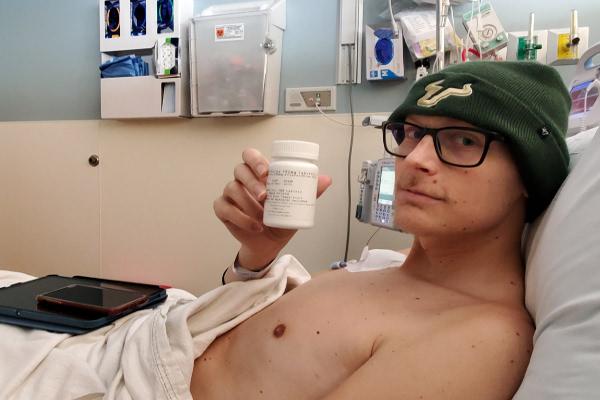
Clinical trial day one is now in the books. We started the morning at the infusion center where Matt had a blood draw. His hemoglobin levels were a little low so we knew he would need to stay a little longer to get a bag of it. His doctors also want hemoglobin levels higher for radiation purposes. His chemo was started soon afterwards. During the chemo treatment a three week supply of DFMO was given to us with instructions on how and when to take it.
It’s a lot of pills (11 in the AM and 10 in the PM) to take as well as to grind in one day, but we’re hoping the payoff will make it worth it. Once chemo ended we headed to the radiation center to get the sacrum radiated on. Following that it was back to the infusion center to get the hemoglobin ‘refilled’. The rest of the week should be a little easier with just chemo/DFMO and radiation scheduled.
A quick recap of DFMO and why we think it will benefit Matt. DFMO (Difluoromethylornithine), known generically as eflornithine and sold under the brand name IWILFIN, represents one of the most remarkable stories of drug repurposing in pediatric oncology. A great news article worth the read here that tells the story: https://pennstatehealthnews.org/2024/09/i-wanted-to-change-the-outcomes-shollers-career-leads-to-neuroblastoma-breakthrough/ It’s the story of a drug that was used many years ago to treat African Sleeping Sickness then collected dust on the shelves over the years until 22 years ago. At that time the now chief of Penn State Health Children’s Hospital’s Division of Pediatric Hematology and Oncology found that DFMO had as a side effect what looked like an ability to stop neuroblastoma. After years of research, clinical trials and FDA fast track approval she got DFMO to the neuroblastoma children who needed it and saw relapse rates drop from 50% to 15%.
How does this pertain to Matt who has Ewing Sarcoma and not neuroblastoma? Time out for a brief science lesson from a guy who didn’t do too well in his science classes. Aggressive pediatric solid tumors like Ewing Sarcoma and neuroblastoma are frequently driven by the amplification of the MYCN or MYC oncogenes. Back in September Beat Childhood Cancer took a sample of Matt’s tumor and sent it out for genomic profiling. A panel of researchers, oncologists and data informaticists reviewed Matt’s case and looked at the findings from the genomic profiling. As in neuroblastoma relapse, the MYCN gene in Matt’s tumor was very highly expressed. These MYCN oncogenes overactivate the ODC1 gene, which forces the cell to produce an excess of polyamines. Polyamines in turn fuel rapid cell division, protein translation, and tumor survival in cancer. By locking down ODC, DFMO strips the cancer cells of the polyamines they depend on, effectively halting tumor cell division, migration, and spread. DFMO was the one drug the panel singled out as being of most benefit for remission for Matt.
Ewing Sarcoma is caused by the fusion of the EWS AND FLI1 genes. These genes are supposed to remain separate but have somehow merged with this cancer. It wasn’t due to a lifestyle choice Matt made. It wasn’t due to anything hereditary that was passed down to him. It’s just a sneaky, random tumor that occurs when normal cellular behavior goes sideways. On average only 200 cases are diagnosed each year in the US. There are 349 million people in the US today. Globally there are estimated to be around 1-2 cases per million children and adolescents per year. Rare might be an understatement.
To date there is no single drug that can target this fused pair, but new research is getting closer to finding a permanent cure. All we can do is target other genes downstream that can affect the survival of the cancer.
It’s kind of like trying to kill a large tree. The easiest thing to do would be to use a chainsaw and cut the trunk. We have no chainsaw. We have only a small hand-axe. So the next best thing is to use the hand-axe and chop away at a major root thus starving the tree of its key nutrients.
DFMO is our hand-axe. Today we start chopping at that root.
your explanation is exemplary ! Matt is in our prayers all the time and we continue to send healing love light and energy
This is an extraordinary summary John. When I worked in the Oncology division at AstraZeneca we hoped for breakthroughs like this all the time (and a side note….the nerd in me actually understood everything you reviewed here!). We continue to pray for all of you every single day. And now I will add “please let DFMO do its job!” Go MATT. ❤️❤️❤️🙏🙏🙏🤓🤓🤓
Thanks Linda! We’re really praying that this neuroblastoma breakthrough also becomes a breakthrough for Ewing Sarcoma and osteosarcoma patients.
Wow! Thank you John so much for this amazing explanation. It is exciting that these discoveries are coming available but I also know how hard it is to wait patiently for the science to mature and get some results that we all are praying for. We are with you all through this.
Yes, especially with this disease. Despite decades of clinical trials, not much progress has been made in improving the outcomes of patients with Ewing Sarcoma. With recent advances in technology we are finally starting to see some more momentum.
Thank you John for taking the time to give us updates and educating us. James & I continue to lift Matt up in prayer and trusting this trial will be an answer to the many prayers we have all poured out. Stay strong Matt & team!
Thank you April and Jim for your continued prayers! We too are hoping this trial will keep the relapses from returning.