

In Ewing Sarcoma EWS-FLI1 Causes A Defect In Microhomology-Mediated End Joining (MMEJ) Repair
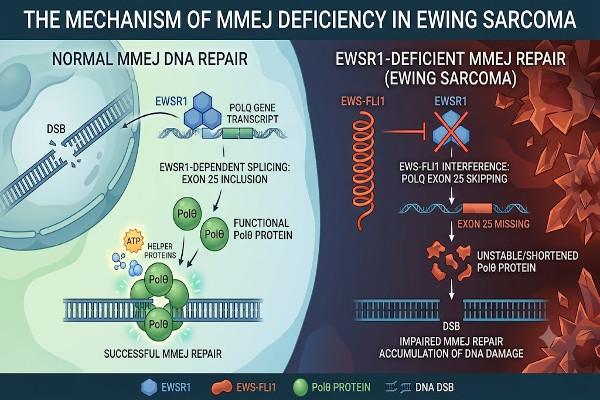
This study reveals that Ewing sarcoma cells have a major defect in a specific DNA repair mechanism called Microhomology-Mediated End Joining (MMEJ). Normally, cells rely on a protein named Polθ (encoded by the POLQ gene) to carry out MMEJ repair when their DNA breaks. However, the disease-causing protein behind Ewing sarcoma, EWS-FLI1, disrupts the cell’s normal machinery by preventing proper splicing of the POLQ gene message. Specifically, it causes a vital piece of genetic instruction—exon 25—to be skipped during protein creation, leading to a shortened, unstable Polθ protein that gets quickly degraded. Without Polθ, Ewing sarcoma tumor cells are unable to repair DNA damage using the MMEJ pathway.
Because these cancer cells have lost their MMEJ DNA repair system, they become hyper-dependent on their remaining backup DNA repair pathways—such as Fanconi Anemia (FA), Homologous Recombination (HR), and Non-Homologous End Joining (NHEJ)—to stay alive. Researchers demonstrated that by using targeted drugs (such as RBM39 degraders, CDK12 inhibitors, or DNA-PK inhibitors) to block these remaining backup pathways, the cancer cells can no longer fix their broken DNA and die off. This concept, known as synthetic lethality, exploits the tumor’s built-in repair flaw, offering a precise roadmap for developing effective, targeted therapies for patients with Ewing sarcoma.
Read the full article