

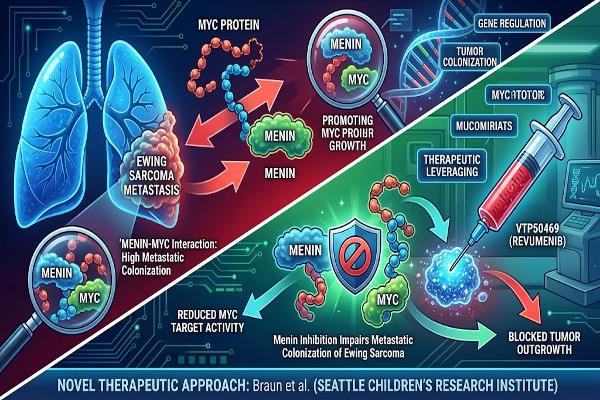
Menin Inhibition Impairs Metastatic Ewing Sarcoma
Ewing sarcoma is an aggressive bone and soft tissue cancer that frequently recurs at distant body sites, leading to poor patient survival rates. In this study, researchers at Seattle Children’s Research Institute investigated the role of Menin—a scaffolding protein that regulates gene expression—in driving Ewing sarcoma progression. While removing or inhibiting the Menin protein had no effect on cancer cell growth in standard laboratory dishes, it severely crippled the ability of those same cells to initiate local tumor growth and colonize distant organs, such as the liver, in mouse models. The findings demonstrate that Menin is critical for allowing circulating cancer cells to embed themselves in new tissue niches and grow into secondary tumors.
At the molecular level, Menin was found to interact directly with the MYC protein—outside its conventional protein complexes—to promote growth-supporting gene programs. When researchers treated mice with VTP50469 (revumenib), a drug that disrupts Menin interactions, the drug partially blocked Menin’s interaction with MYC, reduced MYC target gene activity, and significantly delayed or prevented the formation of metastatic tumors in vivo. Although withdrawing the treatment eventually allowed dormant cancer cells to grow, the study establishes Menin as a central driver of Ewing sarcoma metastasis and suggests that Menin-targeting drugs could be repurposed as a novel strategy to prevent metastatic relapse in high-risk patients.
Read the full article