
Researchers At UNC Receive Grant To Target OTUD7A As A Novel Therapeutic Strategy for Ewing Sarcoma
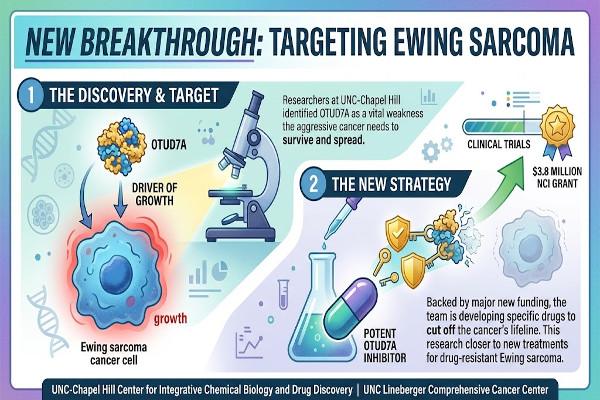
Ewing sarcoma is a rare and aggressive cancer in children and young adults that often returns and becomes resistant to standard treatments like chemotherapy. To solve this, researchers at UNC-Chapel Hill have discovered a specific enzyme called OTUD7A that the cancer relies on to grow. By blocking or removing this enzyme in laboratory tests, the team successfully stopped the tumor’s growth. To turn this discovery into a real-world treatment, the National Cancer Institute has awarded the team a $3.8 million grant to develop specialized drugs that target this vulnerability.
In simpler terms, think of the OTUD7A enzyme as a vital “fuel line” that Ewing sarcoma tumors need to survive and multiply. Because current treatments often fail to keep this cancer from coming back, scientists are building a brand-new type of drug designed to specifically cut off this fuel line. Thanks to new millions in federal funding, the research team can now spend the next five years perfecting this drug so it can safely move out of the lab and into clinical trials, hopefully giving young patients a powerful, targeted weapon against a highly resistant disease.
Read the full article