

Scientists Use Simple Yeast to Uncover How Ewing Sarcoma Protein Operates
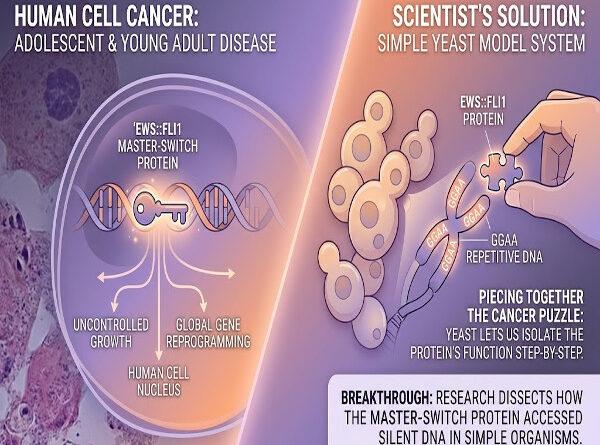
Researchers at IRB Barcelona and the Institut de Recerca Sant Joan de Déu have utilized a simple yeast model to dissect the distinct molecular functions of EWS::FLI1, the primary driver protein behind Ewing sarcoma. By introducing the human fusion protein into yeast cells, scientists were able to separate two key behaviors: the protein’s ability to turn on specific, repetitive DNA segments (GGAA sequences) versus its broader capacity to globally rewrite gene expression. The study revealed that EWS::FLI1 successfully activated normally silent GGAA sequences even inside yeast, but it was unable to alter overall gene expression. This indicates that activating repetitive DNA relies on fundamental, primitive cellular machinery, whereas global gene reprogramming requires more complex molecular components unique to animal cells.
Ewing sarcoma is a rare and aggressive childhood bone cancer caused by a single faulty protein that behaves like an unwanted master switch in cells. To figure out how this protein works step-by-step, scientists put it into yeast—a much simpler organism—to see which of its harmful features still worked without the complex environment of human cells. They discovered that the protein can unlock hidden sections of DNA using basic, ancient cell mechanisms, but needs specialized human cell tools to launch a full-scale takeover. Isolating these functions in yeast gives researchers a streamlined testing ground to pinpoint exact cellular targets and screen for future drugs that can disarm the cancer protein.
Read the full article